
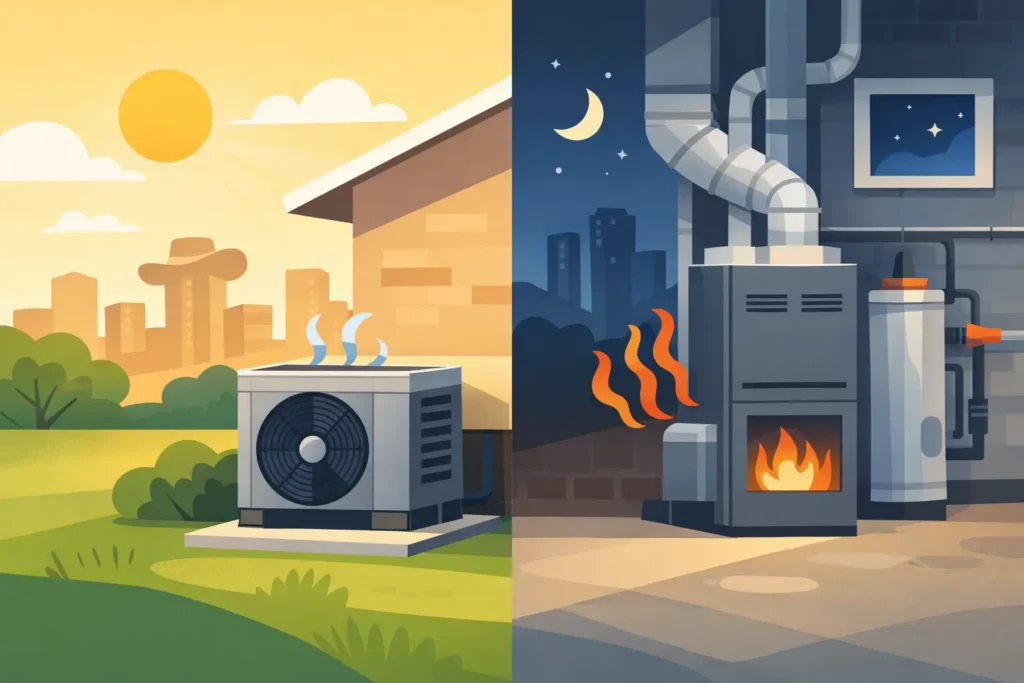
A North Texas winter can start with a mild afternoon and turn sharply cold after sunset. That swing is exactly why the heat pump versus furnace decision deserves more than a quick look at the equipment price. The right system needs to keep your home comfortable during the few hard freezes we get, manage summer heat and humidity, and fit the way your household uses energy.
For many Fort Worth-area homes, either option can be a smart choice. The better fit depends on your current HVAC setup, fuel availability, budget, insulation, and whether you want one system to handle both heating and cooling.
Heat Pump Versus Furnace: The Core Difference
A furnace creates heat. Most homes use a gas furnace, which burns natural gas and moves warmed air through the ductwork. Electric furnaces are available, but they are less common in North Texas because electric resistance heat can be expensive to operate.
A heat pump does not generate heat in the same way. It transfers existing heat from outdoor air into your home during winter. In summer, it reverses direction and works like a central air conditioner, moving heat out of the house. That gives a heat pump a major advantage for homeowners replacing both an aging furnace and an older AC unit.
The practical difference is simple: a furnace is a heating-only appliance, while a heat pump provides heating and cooling in one outdoor-and-indoor system. In a climate with long cooling seasons and relatively moderate winters, that flexibility can be valuable.
When a Heat Pump Makes Sense in North Texas
Heat pumps are especially effective during the cool but not freezing weather common across North Richland Hills, Hurst, Watauga, Bedford, and Fort Worth. Because they move heat rather than create it, they can deliver more heat energy than the electricity they use. That can lower heating costs compared with electric resistance heat and may be competitive with gas heating depending on local utility rates.
A heat pump is often a strong choice when your home needs a new air conditioner anyway. Instead of installing a separate AC and furnace, you can choose equipment that handles both jobs. You also avoid maintaining two primary comfort systems, although the heat pump still needs regular professional service to perform well.
For homeowners who do not have natural gas service, a heat pump is usually worth serious consideration. It can offer much lower operating costs than an electric furnace, particularly during the mild winter days that make up much of a typical North Texas season.
Heat pumps also provide steady, gentle heat. Rather than delivering very hot blasts of air during shorter furnace cycles, they often run longer at lower output. Many homeowners appreciate the more even temperatures, especially with a properly sized variable-speed system.
The cold-weather trade-off
A heat pump’s heating capacity declines as outdoor temperatures fall. Modern systems perform much better in cold weather than older models, but prolonged freezing temperatures can still require supplemental heat. That backup may come from electric heat strips or a gas furnace in a dual-fuel setup.
Heat strips keep the house warm, but they use more electricity than normal heat-pump operation. For a North Texas home, this is not necessarily a deal-breaker. Severe cold is usually brief. Still, it is a factor to discuss before choosing a system based only on high-efficiency ratings.
When a Furnace Is the Better Choice
A gas furnace remains a dependable option for homes with an existing natural gas line and reliable ductwork. It produces strong heat quickly and continues to perform well when temperatures drop below freezing. If your family prefers fast warm-up times or your home tends to feel chilly during cold snaps, a furnace can offer real peace of mind.
Furnaces also make sense when the air conditioner is still in good condition and only the heating equipment needs replacement. Replacing a working AC just to move to a heat pump may not be the most cost-effective decision. A qualified technician can inspect both systems and help determine whether repair, targeted replacement, or a full matched-system installation is the better investment.
Natural gas pricing matters, too. When gas prices are favorable, a high-efficiency furnace can be economical to run. Furnace efficiency is measured by AFUE, or Annual Fuel Utilization Efficiency. A 95% AFUE furnace converts roughly 95 cents of every fuel dollar into usable heat, with the remainder lost through venting and normal operation.
Furnace considerations beyond efficiency
A furnace needs a combustion process, venting, and gas-line connections. Those components are safe when they are properly installed and maintained, but they require professional attention. Annual furnace maintenance should include a heat exchanger inspection, safety-control testing, burner evaluation, and carbon monoxide checks.
A furnace also does not cool your home. In North Texas, that means it must be paired with a central air conditioner or another cooling solution. If both your furnace and AC are near the end of their service life, comparing a complete furnace-and-AC system with a heat pump system is more useful than comparing heating equipment alone.
Cost: Look Beyond the Installation Quote
Upfront cost is part of the decision, but it should not be the only number that matters. Installation pricing varies based on equipment efficiency, home size, duct condition, electrical work, thermostat upgrades, gas connections, and whether the system requires modifications to meet current code.
A basic replacement may cost less than a major upgrade, but an improperly sized system can create years of higher bills and avoidable repairs. Oversized equipment tends to cycle on and off too often. Undersized equipment can struggle to maintain comfort during the hottest or coldest periods. In both cases, the lowest initial quote can become the more expensive choice over time.
Operating costs also depend on the home. Insulation levels, air leaks, window quality, thermostat settings, duct leakage, and household schedules all affect energy use. A heat pump may be highly efficient on paper, but a leaky attic duct can waste much of that advantage. Likewise, even an efficient furnace will work harder if cold air is entering around doors, windows, or poorly sealed attic access points.
Financing can make a higher-efficiency replacement more manageable for homeowners who need dependable equipment now but want to spread out the investment. Ask for clear pricing that separates essential work from optional upgrades so you can make a decision without pressure.
Consider a Dual-Fuel System for the Best of Both
For some North Texas households, the best answer is not strictly a heat pump or a furnace. A dual-fuel system combines a heat pump with a gas furnace. The heat pump handles most heating during mild weather and provides air conditioning in summer. When outside temperatures become cold enough that gas heat is more practical, the furnace takes over.
This setup can provide excellent year-round comfort and gives homeowners a backup heating source for freeze events. It can be particularly appealing for homes that already have natural gas service and need to replace both the AC and furnace.
The trade-off is higher initial cost and more equipment to maintain. Dual-fuel systems need correct setup so the thermostat changes heating sources at the right outdoor temperature. Done correctly, that control strategy can balance comfort and operating cost without requiring you to manage it manually.
Questions to Ask Before Replacing Your System
Before approving a replacement, ask whether the contractor performed a proper load calculation rather than selecting equipment based only on the size of the old unit. Your home’s needs may have changed after window replacements, insulation improvements, additions, or occupancy changes.
Ask how the proposed system will handle freezing temperatures, what backup heat is included, and whether your ductwork can support the new equipment. It is also reasonable to ask about expected maintenance, available warranty coverage, thermostat compatibility, and the estimated operating differences between options.
For commercial properties, the conversation may include additional priorities: occupancy patterns, zoning needs, equipment downtime, ventilation, and the cost of interruptions. A solution that works for a single-family home may not be the right fit for a retail space, office, or rental property.
Choose for Your Home, Not the Sales Pitch
A heat pump is often an efficient, practical fit for Fort Worth’s cooling-heavy climate. A gas furnace offers fast, reliable heat and can be an excellent value for homes with natural gas. A dual-fuel system can bridge the gap for homeowners who want efficient mild-weather operation without giving up strong cold-weather performance.
The most useful next step is a straightforward assessment of your existing equipment, ducts, energy source, and comfort concerns. Malcolm’s HVAC can help homeowners and property managers compare options with upfront guidance, so the system you choose is built around your home and not a one-size-fits-all recommendation.