
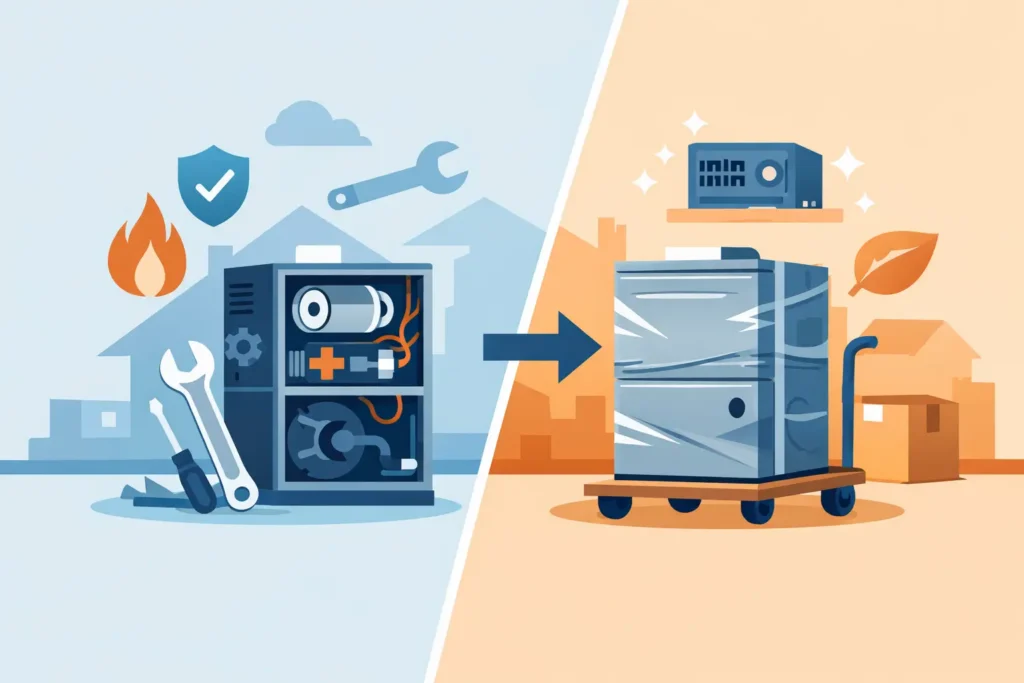
A furnace decision usually shows up at the worst time – on a cold morning, before guests arrive, or right when your budget is already stretched. If you’re asking, should I repair or replace my furnace, you’re probably not looking for a sales pitch. You want a clear answer that makes sense for your home, your comfort, and your wallet.
The truth is, there is no one-size-fits-all rule. Some furnaces have years of dependable service left and only need a targeted repair. Others are costing you more every season through repeat breakdowns, higher utility bills, and uneven heating. The right move depends on the age of the system, the repair needed, the condition of major components, and how reliably the furnace is heating your home.
Should I Repair or Replace My Furnace? Start With Age
Age is one of the strongest clues. Most gas furnaces last around 15 to 20 years with proper maintenance. If your unit is under 10 years old and the issue is limited to something like an igniter, flame sensor, capacitor, or thermostat problem, repair is often the better value.
Once a furnace gets into the 15-year range, the conversation changes. Parts wear down, efficiency drops, and repairs can start stacking up. Even if one fix seems manageable, an older unit may be one failing component away from another service call. At that point, replacement often becomes the more predictable investment.
That does not mean every older furnace should be replaced on sight. A well-maintained system with a solid heat exchanger and no history of major trouble may still be worth repairing. But if your furnace is old enough that parts are harder to find, or if technicians are warning you about multiple weak points, replacement deserves a serious look.
When Furnace Repair Still Makes Sense
A lot of homeowners assume any heating problem means the whole system is done. That is not always true. Many furnace issues are repairable, especially when they are caught early.
Repair is usually the smarter choice when the problem is isolated, the furnace is still within its expected lifespan, and the repair cost is reasonable compared to the value of the system. If your furnace has generally been reliable and this is the first significant problem in years, a repair may restore full performance without putting you into a major expense.
For example, a faulty thermostat, worn blower motor capacitor, clogged filter problem, ignition issue, or sensor malfunction can often be corrected without replacing the entire unit. In those cases, paying for a quality repair can buy you several more seasons of dependable heat.
The key is whether the repair solves the real issue or just delays the next one. If a technician can fix the problem confidently and the rest of the furnace is in good shape, repair is usually a practical decision.
Signs It May Be Time to Replace
Some furnaces tell you pretty clearly that they are nearing the end. You may notice rooms heating unevenly, longer run times, rising gas bills, strange noises, or frequent cycling on and off. Those symptoms do not always mean replacement is required, but they often point to declining performance.
Frequent repair calls are one of the biggest red flags. If your furnace has needed multiple repairs over the last two winters, the pattern matters more than any one invoice. A unit that keeps breaking down is not just expensive. It is stressful, especially when you are trying to keep your family comfortable during a cold snap.
Another major factor is safety. If there is a cracked heat exchanger, combustion issue, or carbon monoxide concern, replacement may be the safest path. A reputable HVAC technician should explain this clearly and show you why the risk is serious.
High energy use is another reason many homeowners replace older systems. Newer furnaces can operate much more efficiently than units installed 15 or 20 years ago. If your heating bills keep climbing even after maintenance and minor repairs, a replacement may lower your monthly operating costs enough to justify the upfront investment over time.
Compare the Repair Cost to the Furnace’s Remaining Life
One useful way to think about this decision is to compare the repair cost with how much useful life the furnace likely has left. Spending a few hundred dollars on a repair for a 7-year-old furnace can be a smart move. Spending a large amount on a 17-year-old unit with a history of problems is harder to justify.
Some homeowners use a simple rule of thumb: multiply the age of the furnace by the estimated repair cost. If the number is high, replacement is often the better long-term value. It is not a perfect formula, but it helps frame the decision.
For example, a $700 repair on a 16-year-old furnace deserves more scrutiny than the same repair on an 8-year-old system. With the older unit, you are paying real money into equipment that may not stay dependable much longer. With the newer one, that same repair may restore years of service.
This is also where financing can matter. A repair may look cheaper today, but if replacement gives you a more reliable system, better efficiency, and warranty protection, the monthly payment can feel more manageable than repeated repair bills.
Should I Repair or Replace My Furnace if It Still Runs?
This is one of the most common questions homeowners ask. A furnace does not have to stop working completely to be a replacement candidate. In fact, many systems continue running long after they stop running well.
If your furnace still turns on but struggles to keep the house warm, runs constantly, creates hot and cold spots, or drives up your utility bills, it may be costing you more than it appears. That said, poor performance can also come from issues outside the furnace itself, such as duct leaks, dirty filters, airflow restrictions, or thermostat problems.
That is why a proper inspection matters. You want to know whether the furnace is truly failing or whether a targeted repair and system tune-up can solve the issue. Honest HVAC guidance should focus on the condition of the full heating system, not just the fastest way to sell new equipment.
Think Beyond the Furnace Itself
A replacement decision is not only about the metal cabinet in the attic, closet, or garage. It is about comfort, reliability, and total home performance.
If your current furnace is oversized, undersized, or poorly matched to your ductwork, replacing it with the right system can improve airflow and temperature balance throughout the house. If your indoor air feels dusty or stale, this may also be a good time to consider filter upgrades or indoor air quality improvements.
For homes in North Richland Hills, Fort Worth, and nearby areas, winter heating needs may not be as extreme as in colder states, but when temperatures drop, you still need equipment you can trust. A furnace that fails during a Texas cold front does not care that the average winter is mild.
What a Good HVAC Recommendation Should Include
Whether you lean toward repair or replacement, the decision should come with clear reasoning. A trustworthy technician should explain what failed, what condition the rest of the system is in, how much the repair costs, and what to expect going forward.
If replacement is recommended, you should also hear why. Is the furnace unsafe? Is the repair cost too high for the age of the equipment? Are major components worn out? Is efficiency so low that keeping the unit no longer makes financial sense? Those details matter.
You should also receive upfront pricing and realistic options. Some homeowners want the most budget-friendly repair to get through the season. Others want to avoid more breakdowns and invest in a new system now. Both are reasonable goals when the advice is honest.
Family-owned companies like Malcolm’s HVAC understand that furnace decisions are not just equipment decisions. They affect household budgets, schedules, and peace of mind. That is why a good recommendation should feel practical, not pressured.
The Best Time to Decide
The best time to decide is before your furnace leaves you without heat. If your system is aging, making unusual noises, or requiring frequent service, it is worth having it evaluated before it becomes an emergency.
A planned replacement usually gives you more control over budget, scheduling, and equipment choice. Waiting until the furnace fully fails often turns the decision into a rushed one. And rushed decisions are rarely the most cost-effective.
If you are on the fence, ask for a straightforward assessment of both paths. What does the repair buy you? How much life is realistically left? What would replacement improve right away? Once those answers are on the table, the right next step is usually much easier to see.
A good furnace decision should leave you feeling confident, not cornered. If your system is still worth fixing, fix it. If it is draining money and reliability, replacing it may be the smarter move for your home and your comfort.