
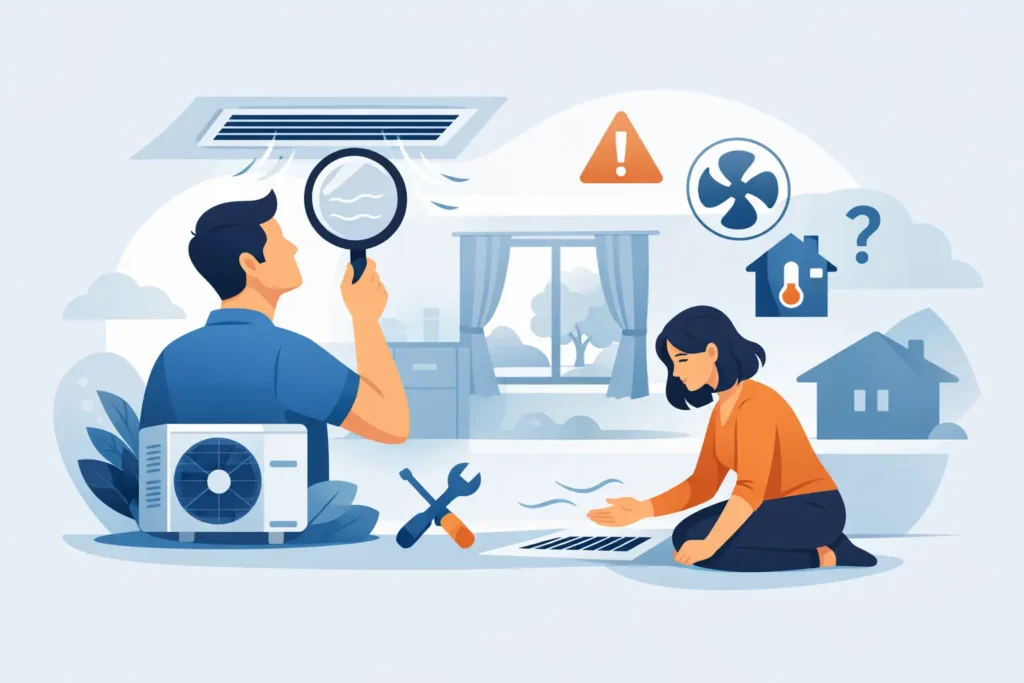
A room that never cools down in a Texas summer is more than an inconvenience. When one or more vents barely move air, your system has to run longer, comfort becomes uneven, and utility costs can rise. Knowing how to troubleshoot weak airflow can help you identify a simple issue quickly and recognize when your HVAC system needs professional attention.
Before you adjust equipment or remove a panel, start with what you can safely see and hear. Weak airflow is often caused by a restriction somewhere between the return grille and the supply vents. In other cases, it points to a blower, ductwork, thermostat, or system-sizing problem that requires a trained technician.
Start by Identifying Where Airflow Is Weak
First, walk through the home and compare the airflow from each supply vent while the air conditioner or heater is running. Is weak airflow affecting every room, only one floor, or just a single room? That distinction matters.
If every vent has weak airflow, the issue may involve a clogged filter, failing blower motor, dirty indoor coil, or a setting at the thermostat. If only one or two rooms have the problem, look more closely at closed vents, damaged ductwork, blocked registers, or rooms that receive more direct sun than the rest of the house.
Pay attention to timing as well. Airflow that drops after the system runs for 20 to 30 minutes can indicate an evaporator coil beginning to freeze. Airflow that is always weak, whether the system is heating or cooling, may point to the blower or duct system.
How to Troubleshoot Weak Airflow Safely
Check the air filter first
A dirty air filter is one of the most common and most preventable causes of reduced airflow. When dust, pet hair, and debris build up on the filter, the blower has to work harder to pull air through the system. That can leave rooms feeling stuffy and place unnecessary strain on the equipment.
Turn the system off, locate the filter, and inspect it in good light. If it looks gray, matted, or visibly coated in dust, replace it with the correct size and type. Most homes benefit from checking filters monthly and replacing them every one to three months, depending on pets, allergies, construction dust, and how often the system runs.
A higher-rated filter is not always better for every system. Very dense filters can restrict airflow if the HVAC equipment was not designed for them. If airflow worsened after changing filter types, ask an HVAC professional which filter rating fits your system and indoor air quality needs.
Make sure vents and return grilles are open
It is tempting to close vents in unused rooms to save money. In many central HVAC systems, however, closing too many supply vents can create pressure problems and reduce overall performance. Keep supply registers mostly open, especially in rooms that share the same duct run.
Also check return air grilles. Returns pull air back to the system so it can be heated or cooled again. Furniture, curtains, storage bins, and rugs should not block them. A large sofa placed directly in front of a return grille can limit airflow throughout the home, even when every supply vent is open.
Check the thermostat fan setting
Look at the thermostat and confirm the fan is set to Auto, not On, unless you intentionally want continuous air circulation. The On setting keeps the fan running between heating and cooling cycles. That is not always a problem, but the air may feel weak or warmer during AC operation because the fan continues moving unconditioned air after the cooling cycle ends.
If your thermostat has changed settings, lost programming, or displays an alert, correct that first. A thermostat issue will not usually cause a single weak vent, but it can affect how long and how effectively the entire system operates.
Inspect accessible duct connections
If you have accessible ductwork in an attic, garage, crawlspace, or mechanical room, look for obvious problems without stepping on ceilings or disturbing insulated sections. Loose, crushed, torn, or disconnected ducts can send conditioned air into an attic instead of the room where it belongs.
A disconnected duct often causes one room to have dramatically weaker airflow than the rest of the house. You may also notice a dusty smell, hot attic air, or a room that never reaches the thermostat setting. Do not use ordinary tape as a long-term duct repair. Ducts need to be properly sealed, supported, and insulated to prevent repeated air loss.
Watch for Signs of a More Serious HVAC Problem
Some airflow issues are not safe or practical to solve with a quick homeowner check. Turn the system off and arrange service if you notice ice on refrigerant lines, water around the indoor unit, a burning smell, loud rattling, repeated breaker trips, or a blower that does not start reliably.
A frozen evaporator coil is especially common during heavy North Texas cooling season. Low refrigerant, a dirty coil, a clogged filter, or a blower problem can all contribute to freezing. Continuing to run the system can damage the compressor and turn a manageable repair into a larger expense.
Weak airflow can also come from a dirty indoor coil, a failing blower capacitor, worn blower motor, or a malfunctioning control board. These repairs involve electrical components and sealed HVAC equipment. Professional diagnostics are the safest way to find the actual cause instead of replacing parts based on a guess.
Why One Room May Have Poor Airflow
A single uncomfortable room does not always mean the air conditioner or furnace is failing. Bedrooms over garages, upstairs rooms, additions, and west-facing rooms often carry a bigger heat load than the rest of the home. Long duct runs, undersized ducts, and air leaks can make the difference more noticeable.
Start by checking that the room’s vent is open, unobstructed, and clean. Then consider the room itself. Leaky windows, poor attic insulation, a hot garage below, and unsealed doors can make a room feel under-conditioned even when airflow is normal.
The right solution depends on the cause. Duct repair may help if air is escaping before it reaches the room. A balancing adjustment may improve distribution in some systems. In other cases, added insulation, better window protection, a zoning solution, or a properly sized duct modification is the better long-term answer. Portable fans can improve comfort, but they do not correct an HVAC airflow restriction.
Avoid These Common Airflow Mistakes
Do not keep lowering the thermostat when air barely moves from the vents. Lowering the set temperature does not increase blower capacity. It simply tells the system to run longer, which can increase wear and energy use.
Avoid covering vents to redirect air into another room. Central HVAC systems are designed around balanced airflow, and forcing air away from several rooms may create noise, pressure buildup, and uneven temperatures. It is also wise not to spray cleaners into ducts, remove blower panels, or handle electrical components without the right training.
For commercial properties, airflow problems deserve prompt attention as well. A weak supply diffuser in an office, retail area, or tenant space can affect customer comfort, employee productivity, and equipment performance. Commercial systems may involve larger duct networks, multiple zones, or rooftop units, so a professional inspection can save time and reduce disruption.
When to Call an HVAC Professional
Call for service when replacing the filter and clearing vents does not restore normal airflow, when the problem returns repeatedly, or when some rooms are consistently uncomfortable. An HVAC technician can measure static pressure, inspect the blower, check duct integrity, evaluate the indoor coil, and verify that the system is operating within manufacturer specifications.
At Malcolm’s HVAC, our team helps homeowners and property managers across North Richland Hills, Fort Worth, Haltom City, Richland Hills, Watauga, Bedford, Euless, and Hurst get clear answers without unnecessary pressure. Upfront diagnostics can identify whether you need a straightforward repair, duct service, maintenance, or a longer-term equipment solution.
If weak airflow is leaving your home hot, humid, or uneven, start with the filter, vents, and return grilles. If those simple checks do not solve it, timely service can protect your comfort and help prevent a small airflow issue from becoming a major system failure.