
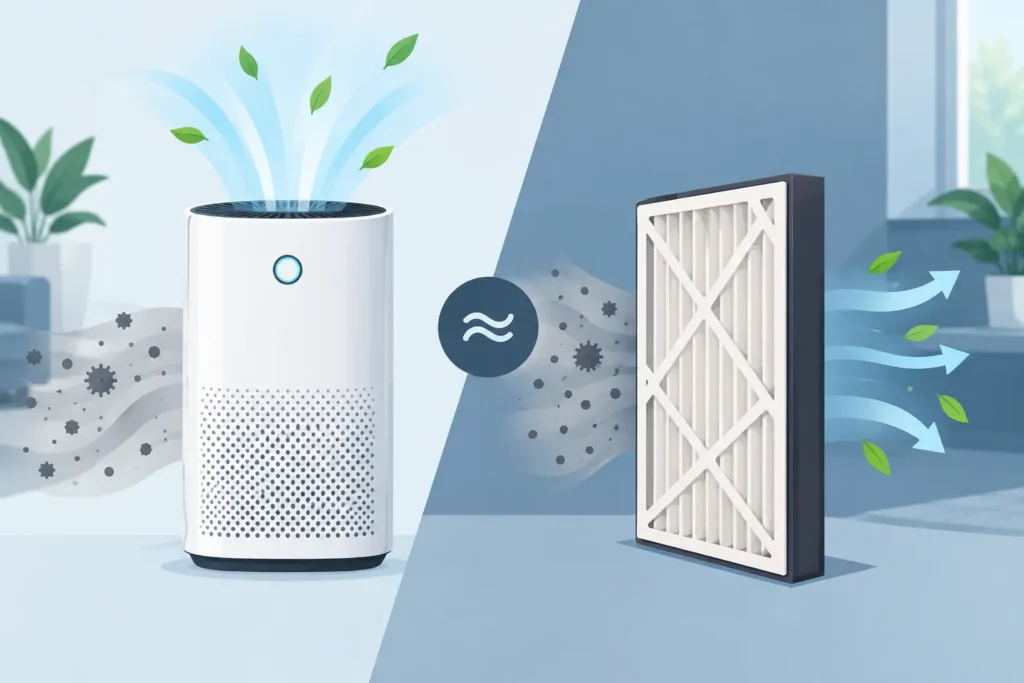
A dusty return vent, lingering pet odors, or a family member who seems to sneeze more indoors can make homeowners ask the same question: air purifier versus media filter, which one will actually help? The answer depends on what is in your air, how your HVAC system is built, and whether you need better filtration throughout the house or added treatment for a particular room.
For homes in North Richland Hills, Fort Worth, and nearby communities, indoor air quality is not a one-size-fits-all issue. Texas pollen, outdoor dust, pet dander, cooking odors, and normal household activity all affect the air moving through your home. A properly selected media filter or air purifier can help, but they solve different parts of the problem.
Air Purifier Versus Media Filter: The Core Difference
A media filter is installed as part of your central heating and cooling system. Every time the system runs, air passes through the filter before moving across critical equipment and back into the home. Its primary job is to capture airborne particles, protect HVAC components, and improve the quality of circulated air.
An air purifier is a separate device or an added indoor air quality component. Portable purifiers typically clean the air in one room, while whole-home air purifiers are installed in the ductwork and treat air as it travels through the HVAC system. Depending on the technology, they may target particles, odors, gases, or certain airborne contaminants.
The practical difference is coverage and purpose. A media filter is a foundation for any forced-air HVAC system. An air purifier can be a useful supplement when particle filtration alone does not address your specific concern.
What a Media Filter Does Well
Not all HVAC filters are alike. The inexpensive one-inch filters found at many stores are often designed mainly to keep larger debris away from your equipment. A high-quality pleated media filter has more surface area and can capture smaller airborne particles without needing replacement as often as a basic filter.
Media filters are usually rated with a MERV rating, short for Minimum Efficiency Reporting Value. Higher MERV ratings capture finer particles, but higher is not automatically better for every system. A filter that is too restrictive can reduce airflow, make the equipment work harder, and contribute to comfort or performance problems if the ductwork and system were not designed for it.
For many homes, a properly sized media cabinet with an appropriate filter provides a meaningful improvement in dust control, pollen capture, and pet dander management. It also helps keep the evaporator coil, blower, and other internal components cleaner. That can support efficient operation and reduce the buildup that leads to service issues over time.
A media filter is especially sensible when your main concerns are whole-home dust, seasonal allergies, pet hair, and protecting a newer HVAC system. It is also typically the simpler option to maintain. Most larger media filters are changed on a schedule based on their size, household conditions, and manufacturer guidance, often every several months rather than every month.
Where an Air Purifier Can Add Value
Air purifiers come in several forms, so the results depend heavily on the product and installation. A portable unit with a properly sized mechanical filter can help improve air in a bedroom, nursery, office, or other single space. This can be helpful when one person has stronger sensitivities or when closing a door at night limits how much central air reaches the room.
Whole-home air purifiers are installed with the HVAC system and can treat air across the house when the blower operates. Some rely on enhanced mechanical filtration. Others use activated carbon to help with odors and certain gases. Certain products use electronic or UV-based technology, but those options should be selected carefully for the actual problem and installed according to manufacturer requirements.
An air purifier may be worth considering when odors are a persistent concern, when smoke or chemical smells enter the home, or when a family wants an extra layer beyond HVAC filtration. It can also make sense for commercial spaces where occupancy, cleaning products, and varying room use create more complicated air-quality demands.
Still, an air purifier cannot correct an underlying HVAC issue. It will not fix a dirty coil, leaky ductwork, excess humidity, a clogged drain, or a system that is too small for the home. If indoor air feels stale or musty, the first step is identifying the source rather than adding equipment around the symptom.
Filter Strength, Airflow, and Your HVAC System
One of the most common mistakes homeowners make is installing the highest-rated filter they can find and assuming it will deliver the cleanest air. Your furnace or air handler needs a specific volume of air moving through it. Restrict that airflow too much, and you can create problems that cost more than the filter upgrade is worth.
Warning signs can include weak airflow from vents, uneven temperatures, unusual system noise, a frozen air conditioner coil, or a furnace that cycles off too quickly. These symptoms have several possible causes, but an overly restrictive or neglected filter should always be checked.
This is why filter selection should be connected to the full HVAC system, not just a number on a package. A technician can look at the return setup, filter cabinet, duct condition, equipment specifications, and household needs before recommending a MERV range or a media filter upgrade. For many Fort Worth-area homes, that assessment prevents an indoor air quality improvement from becoming an airflow problem.
Cost and Maintenance Differences
A media filter is generally the more affordable starting point, particularly if your system already has a compatible filter cabinet. The ongoing expense is predictable: replace the filter at the recommended interval and keep the return grille area clear.
A portable air purifier has a lower initial cost than a whole-home model, but it only covers the space it is rated to handle. It also requires electricity, regular filter replacement, and correct placement. Tucking a unit behind furniture or buying one that is undersized for the room limits its benefit.
Whole-home air purification is a larger investment because it requires professional installation and may involve electrical work, duct modifications, or a compatible HVAC configuration. It offers broader coverage, but it is not necessary for every household. In many cases, upgrading the central media filter and keeping up with HVAC maintenance delivers the practical results a family is looking for.
When a Media Filter Is the Better Choice
Choose a media filter upgrade when you want reliable whole-home particle filtration, cleaner HVAC components, and straightforward maintenance. It is often the best first improvement for homes with visible dust, pets, seasonal pollen, or a standard one-inch filter that needs frequent changes.
It is also a smart choice when you are replacing heating and cooling equipment. Building a properly sized filter cabinet into a new installation is often easier than trying to add one later. The goal is to improve filtration without sacrificing the airflow your new system needs.
When an Air Purifier Makes More Sense
An air purifier is more compelling when you have a targeted concern that filtration may not fully handle. A bedroom purifier can help concentrate treatment where someone sleeps. A whole-home solution may be a better fit for households dealing with recurring odors, smoke concerns, or a desire for more comprehensive air treatment alongside a properly selected media filter.
The best setups are often not an either-or decision. A quality media filter handles the everyday work of capturing particles across the home, while an air purifier adds support where its technology and coverage genuinely match the problem.
Before purchasing either option, have your HVAC system evaluated and describe what you are noticing: dust, odors, allergy symptoms, humidity, hot and cold rooms, or frequent filter clogging. Malcolm’s HVAC can help homeowners and property managers sort out the cause, explain practical options, and choose an indoor air quality solution that fits the home instead of adding equipment that does not solve the problem.
Clean indoor air starts with a system that moves air properly, stays maintained, and uses the right tools for the conditions inside your home.