
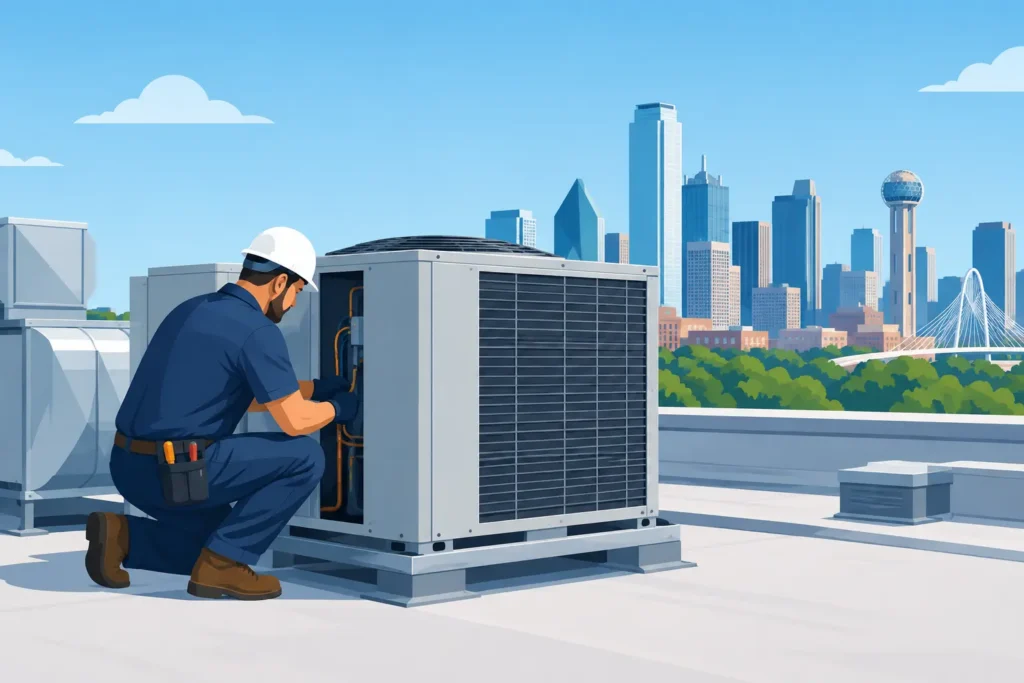
A commercial HVAC replacement can affect far more than the thermostat. It influences tenant comfort, employee productivity, energy use, equipment downtime, and your operating budget for years to come. This commercial HVAC installation guide gives Fort Worth-area property owners and managers a practical way to plan the job, ask better questions, and avoid costly shortcuts.
Commercial systems are not one-size-fits-all. A small retail suite, a medical office, a restaurant, and a warehouse can all have very different cooling loads, ventilation requirements, operating hours, and zoning needs. The right answer starts with the building itself, not with a quick equipment swap.
Start With the Building, Not the Old Unit
Many commercial installations begin because an existing rooftop unit, split system, furnace, or heat pump has become unreliable. That is a valid reason to replace equipment, but matching the old unit’s tonnage without a closer review can create a new set of problems.
A qualified contractor should evaluate the square footage, ceiling height, insulation, window exposure, occupancy, heat-producing equipment, operating schedule, and current comfort complaints. A west-facing storefront in North Richland Hills may struggle with afternoon heat differently than an office building in Fort Worth with a crowded server room or a warehouse with large loading doors.
The goal is accurate load calculation and system design. An oversized system may cool the space too quickly, leaving humidity behind and cycling on and off more often. An undersized system may run constantly during a Texas summer without keeping up. Either situation can raise utility bills and shorten equipment life.
If the building has changed since the current system was installed, bring that up early. Added offices, new machinery, expanded seating, altered hours, or a change in how the space is used may all affect the recommended capacity.
Choose the Right Commercial HVAC System
The best equipment type depends on the property layout, existing infrastructure, budget, and long-term plans for the building. A straightforward replacement is sometimes the most practical choice, especially when the ductwork and electrical service are in good condition. Other times, a system change can solve persistent comfort issues.
Packaged rooftop units remain common for retail spaces, offices, and light commercial properties because most components are housed in one accessible unit. They can be a sensible option when roof access is safe and the building already supports that layout. Split systems place the indoor and outdoor components separately and may work well where rooftop placement is impractical.
Heat pumps deserve consideration for many North Texas properties. They provide cooling in summer and heating during milder winter weather, which can reduce reliance on gas heat in some applications. However, the best heating strategy depends on the building’s needs, local utility costs, and how the space performs during colder stretches.
For properties with multiple zones or varying occupancy, variable refrigerant flow systems and zoning controls may offer stronger comfort control. They can cost more upfront and require proper design and specialized service, so they are not automatically the right fit. The value comes from matching equipment to how each area of the building is actually used.
A Commercial HVAC Installation Guide to Proper Sizing
Sizing is where a commercial HVAC installation guide becomes especially valuable. Equipment capacity is only one part of the calculation. Airflow, ventilation, duct condition, return-air design, and controls all have to work together.
An installation team should inspect whether the existing ductwork can handle the new system’s airflow. Leaky, undersized, poorly insulated, or improperly routed ducts can waste conditioned air before it reaches the rooms that need it. In some buildings, duct repairs or modifications provide as much comfort improvement as the new unit itself.
Ventilation also matters. Commercial spaces need an appropriate supply of outdoor air, but bringing in outside air during hot, humid Texas weather adds to the cooling load. Restaurants, salons, gyms, and medical settings may have additional requirements or unique air-quality concerns. A contractor should account for exhaust systems, fresh-air intake, filtration, and humidity management before finalizing the design.
Do not overlook electrical capacity. New high-efficiency equipment may have different electrical requirements than older units. Verifying the disconnect, breaker size, wiring condition, and available power before installation day helps prevent delays and surprise change orders.
Plan the Project Around Business Operations
A quality installation plan protects your schedule as well as your equipment. For many businesses, a shutdown during regular hours means lost revenue, unhappy tenants, or uncomfortable employees. Discuss timing before equipment is ordered.
A contractor may be able to schedule work before opening, after closing, or over a weekend. Some jobs can be completed with limited interruption, while others require a planned outage for electrical work, crane placement, duct modifications, or system changeover. It depends on the building and the scope of work.
For rooftop replacements, the plan should address crane access, parking restrictions, safe work zones, and weather. For interior equipment, it should address access routes, ceiling protection, noise, dust control, and tenant communication. A clear plan is not extra paperwork. It is how you keep an installation from becoming a disruption.
Understand Pricing Before Work Begins
Commercial HVAC pricing reflects more than the nameplate cost of a unit. The final investment can include equipment, labor, crane service, permits, controls, curb adapters, ductwork changes, electrical upgrades, refrigerant work, disposal of old equipment, and startup testing.
An upfront proposal should identify what is included and what assumptions were made. If a quote is significantly lower than another, ask whether it includes the same efficiency rating, warranty coverage, controls, installation materials, permits, and commissioning work. A low initial number can become expensive if key items were left out.
Efficiency upgrades also require a practical conversation. Higher-efficiency equipment may reduce operating costs, but the payback depends on run time, energy rates, maintenance, and the condition of the rest of the system. A business that operates long hours may see more value from efficiency improvements than a lightly used space. Financing can make a needed replacement more manageable, but it should support a sound equipment decision rather than encourage unnecessary upgrades.
Do Not Skip Permits, Codes, and Commissioning
Permits and code requirements protect the building, its occupants, and the investment you are making. Requirements can vary by municipality, so a project in Haltom City may not follow the exact same process as one in Fort Worth, Hurst, or Bedford. Your contractor should handle the applicable permitting process and install equipment according to local requirements and manufacturer specifications.
After the physical installation, the system needs to be commissioned. This is the process of verifying that the equipment operates as designed. It should include checking refrigerant charge, airflow, electrical readings, thermostat or control operation, drainage, safety controls, and temperature performance.
Before the project is closed out, make sure you receive the information needed to operate and maintain the system. A complete handoff should include:
- Equipment model and serial numbers for your records
- Warranty details and registration requirements
- Basic instructions for thermostats or building controls
- Filter sizes and recommended replacement intervals
- A preventive maintenance schedule tailored to the equipment
Protect the New System With Maintenance
A new commercial system still needs regular attention. North Texas heat places serious demand on air conditioners, and small issues can grow quickly when equipment is running hard. Dirty filters, clogged drains, loose electrical connections, worn belts, and dirty coils all affect performance.
Preventive maintenance gives technicians a chance to spot issues before they become an emergency call. It also supports efficiency, indoor air quality, and warranty compliance. The right service interval depends on the type of equipment and how hard it works. A busy restaurant or high-occupancy retail space may need more frequent service than a lightly used office.
Keep a simple record of service visits, repairs, comfort complaints, and utility changes. That history helps identify recurring problems and gives you better information when it is time to plan the next repair or replacement.
When you are ready to replace or install commercial HVAC equipment, choose a local contractor who will inspect the whole system, explain the options in plain language, and provide straightforward pricing before work begins. Malcolm’s HVAC helps businesses across North Richland Hills and the greater Fort Worth area make comfort decisions that fit their building, budget, and day-to-day operations.