
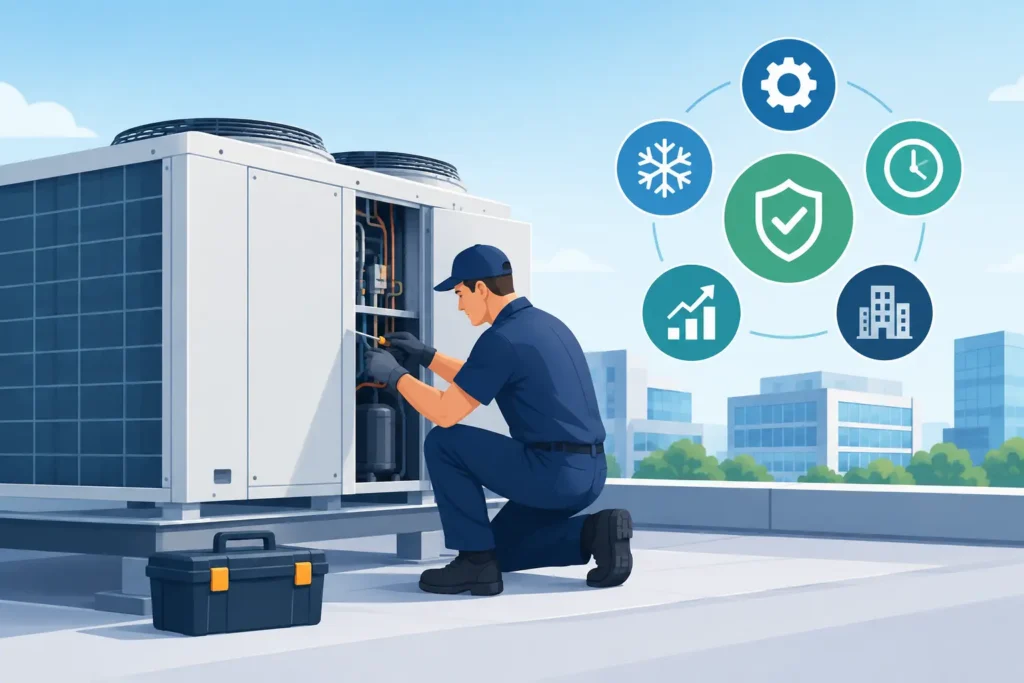
A failed rooftop unit at 2 p.m. in a Fort Worth summer is more than a comfort problem. It can send customers out the door, slow employee productivity, put inventory at risk, and create an urgent call for your facilities team. The best way to reduce commercial HVAC downtime is to treat your equipment as a business-critical asset before it becomes an emergency.
For offices, retail spaces, restaurants, warehouses, medical practices, and multi-tenant properties, HVAC reliability depends on more than replacing a filter when someone remembers. It takes a practical maintenance plan, quick attention to warning signs, and clear decisions about when repair is no longer the sensible option.
1. Schedule Maintenance Before Peak Demand
The busiest time to need air conditioning service is usually the worst time for a system to fail. In North Richland Hills and across the Fort Worth area, cooling equipment works especially hard through long stretches of Texas heat. A unit that was barely keeping up in spring can fail completely once outdoor temperatures climb.
Commercial maintenance should be scheduled before heavy cooling and heating seasons. During a service visit, a qualified technician can inspect electrical connections, test capacitors and contactors, clean coils, verify refrigerant performance, check drains, examine belts and motors, and confirm that thermostats and controls are operating correctly.
These visits do not guarantee that a part will never fail. They do make it far more likely that worn components, airflow restrictions, and drainage issues will be found while there is time to plan a repair. That difference matters when your alternative is closing part of your building on the hottest day of the year.
2. Watch for Small Changes in Performance
Most commercial HVAC failures give some warning. The trouble is that those signs are often written off as normal building quirks until comfort complaints become impossible to ignore.
Pay attention when tenants or employees report uneven temperatures, weak airflow, unusual noises, sticky indoor conditions, short cycling, or rooms that take too long to cool down. Rising utility bills can also point to a system that is running longer than it should because of dirty coils, refrigerant concerns, failing controls, or restricted airflow.
A water stain near an air handler or a drain pan that repeatedly overflows deserves prompt attention as well. Clogged condensate drains can shut equipment down, damage ceilings, and contribute to indoor air quality concerns. A small service call is usually easier to schedule and manage than a water-related repair after hours.
3. Keep Airflow From Becoming a Major Failure
Airflow is one of the most overlooked causes of commercial HVAC strain. Dirty filters force equipment to work harder. Blocked supply vents, closed dampers, damaged ductwork, and clutter around indoor or outdoor units can all prevent conditioned air from moving where it needs to go.
Assign responsibility for checking filters and keeping access around equipment clear. In a restaurant, retail stockroom, or warehouse, this is especially important because daily operations can gradually block mechanical areas without anyone realizing it. Filters may need replacement more often in dusty spaces, high-occupancy buildings, or facilities with frequent door traffic.
The right filter is not always the most restrictive filter. Higher-efficiency filtration can support better indoor air quality, but it must be matched to the equipment and airflow requirements. A technician can help balance filtration goals with the system’s capacity so an air quality upgrade does not create unnecessary stress on the unit.
4. Build a Clear Response Plan for HVAC Problems
When the building gets hot, confusion adds downtime. Property managers and business owners should know who can approve repairs, where equipment records are kept, which areas are most critical, and how to reach their HVAC provider after normal business hours.
Keep basic information available for each unit, including make, model, approximate age, service history, warranty details, thermostat locations, and notes about recurring issues. If your property has several rooftop units, label them clearly. That simple step helps technicians diagnose the right system faster and prevents delays caused by searching for equipment access or trying to identify the affected zone.
Your response plan should also account for temporary comfort measures. For a small office, moving staff to a cooler area may be enough while a repair is completed. For a medical office, server room, restaurant, or tenant space with temperature-sensitive operations, the stakes may be higher. Those properties may need priority service arrangements, temporary cooling options, or a replacement plan already discussed before an emergency occurs.
5. Repair Aging Equipment Before It Fails at the Wrong Time
There is a point where repeated repairs stop being a cost-saving strategy. An older commercial system may still run, but frequent breakdowns, hard-to-find parts, declining efficiency, and unreliable comfort can make it expensive in ways that do not show up on one repair invoice.
Replacement is not automatically the right choice whenever a unit needs work. A newer system with a clearly isolated issue may be a good repair candidate. But if a unit has a history of compressor problems, refrigerant leaks, electrical failures, or repeated service calls during peak season, it is worth comparing the repair cost with the cost of planned replacement.
Planned replacement gives you more control. You can select equipment that fits the building load, coordinate installation around business hours, consider financing options, and avoid making a rushed decision during an outage. An HVAC professional should explain the condition of your current equipment in plain language, including what can reasonably be repaired and what risks remain.
6. Make Controls and Thermostats Part of the Maintenance Plan
A commercial HVAC system can be mechanically sound and still create downtime if controls are not communicating correctly. Faulty thermostats, damaged sensors, programming errors, tripped disconnects, and control board issues can cause erratic cycling or leave an entire area without cooling.
Review thermostat schedules when business hours change. A space that recently added weekend shifts, extended retail hours, or new tenants may be operating on an outdated schedule. Staff should also know which settings they can adjust and which should be left to a manager or technician. Frequent manual changes can hide a larger problem and create inconsistent comfort from one day to the next.
For larger properties, zoning deserves special attention. If one zone is consistently too warm or too cold, do not assume the answer is simply lowering the thermostat. The cause could be airflow imbalance, a damper issue, poor sensor placement, duct leakage, or equipment that no longer matches the space.
7. Choose a Service Partner That Knows Your Property
Fast response is valuable, but familiarity can be just as valuable. A service team that understands your equipment layout, recurring concerns, access procedures, and operating priorities can often diagnose problems more efficiently when a call comes in.
Malcolm’s HVAC works with commercial property decision-makers throughout North Richland Hills, Fort Worth, Haltom City, Hurst, Bedford, Euless, Watauga, and nearby communities. A dependable local relationship means you can ask practical questions before a system becomes urgent, receive upfront guidance on repair options, and make decisions based on your building’s needs rather than pressure.
Reduce Commercial HVAC Downtime With Better Records
Service history is not paperwork for paperwork’s sake. It helps identify patterns. If the same unit has needed a capacitor twice, tripped a breaker repeatedly, or struggled to cool the same zone every summer, those details help guide the next decision.
Keep copies of invoices, maintenance findings, recommended repairs, and replacement estimates in one place. Review them at least once a year, ideally before the cooling season. This gives you a chance to budget for known needs instead of waiting for an unexpected failure to decide for you.
The goal is not to spend money on every possible upgrade. It is to make informed choices that protect your occupants, your operations, and your equipment. When your HVAC system starts showing signs of trouble, scheduling service early can turn a disruptive outage into a manageable repair.