
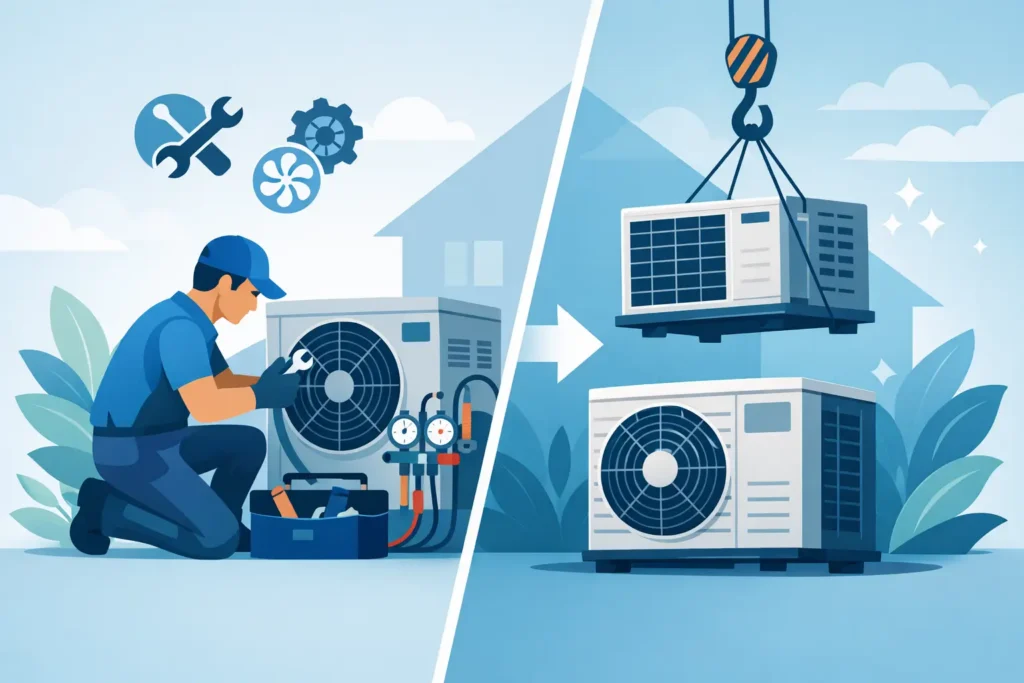
A Fort Worth summer does not leave much room for a weak air conditioner. When you are comparing repairing AC versus replacing unit options, the right answer is rarely just the lowest price today. It is the choice that restores dependable comfort without putting you back in the same stressful situation a few weeks or months from now.
A failed capacitor, clogged drain line, or worn contactor may call for a straightforward repair. But an older system with repeat breakdowns, costly refrigerant issues, and rising energy bills may be telling you it is time to plan for replacement. A qualified HVAC technician should help you see that difference clearly, with upfront numbers and no pressure.
Repairing AC Versus Replacing Unit: Start With the Failure
The first question is simple: what actually failed? Many common AC problems are repairable, even when the system stops cooling completely. Electrical components wear out. Drain lines clog in humid weather. A blower motor can fail while the rest of the equipment remains in sound condition. If the unit is otherwise operating efficiently and has been maintained, repairing it can be the practical choice.
Replacement becomes more reasonable when the repair involves a major component or exposes larger system problems. A failed compressor, leaking evaporator coil, or repeated refrigerant leak can be expensive to address. Those repairs do not automatically mean a new unit is necessary, but they should prompt a closer look at the system’s age, condition, and expected service life.
The goal is not to replace equipment that can be fixed responsibly. It is to avoid spending substantial money on a system that is likely to need another major repair soon.
Age Matters, but It Does Not Decide Everything
Most central air conditioning systems last around 10 to 15 years, though actual lifespan depends on maintenance, installation quality, run time, and outdoor conditions. In North Richland Hills and the greater Fort Worth area, air conditioners work hard for long stretches of the year. That heavy demand can make neglected systems wear out sooner.
A unit under 10 years old is often worth repairing if the issue is isolated and the repair is reasonably priced. Parts may still be available, and the system may have several useful years left. An older unit can also be repaired successfully if it has been well maintained and the needed fix is minor.
Once a system is past the 12- to 15-year range, the calculation changes. Efficiency typically declines over time, parts can become harder to source, and one repair may lead to another. Replacing the system may offer more predictable comfort and a better long-term cost, especially if the unit has struggled through more than one Texas summer.
Compare the Repair Cost to What You Gain
A common rule of thumb is to consider replacement when a repair approaches 40 to 50 percent of the cost of a comparable new system. That guideline is useful, but it is not a final answer. A $1,500 repair on a relatively new system may make sense. The same repair on a 16-year-old unit with high utility bills and a history of service calls may not.
Ask what the repair will accomplish. Will it address one failed part and return the system to normal operation? Or will it only get the unit running while other aging components remain at risk? A trustworthy technician can explain the repair’s likely outcome rather than simply presenting a price.
It also helps to look beyond the outdoor condenser. Your indoor coil, furnace or air handler, thermostat, ductwork, and electrical connections all affect performance. Installing a new AC unit without addressing significant airflow or duct issues may leave comfort problems unresolved. In some homes, a targeted repair plus duct correction is the better investment. In others, a properly matched full-system replacement delivers the stronger result.
Energy Bills Can Reveal an Aging System
If your cooling bills have climbed even though your household habits have not changed, the AC system may be losing efficiency. Dirty coils, failing components, duct leaks, poor insulation, and thermostat problems can all contribute. These issues should be checked before assuming replacement is the only answer.
Still, an older air conditioner generally uses more electricity than a properly sized modern system. New equipment is built to meet higher efficiency standards and can provide more consistent cooling, particularly when paired with the right thermostat and airflow setup. Savings vary by home, equipment choice, insulation, and how much you run the system, so it is best to view lower utility costs as one part of the decision rather than a guaranteed payback figure.
For a family that plans to remain in the home for several years, improved efficiency and fewer surprise repairs can make replacement easier to justify. For a property owner preparing to sell or managing a short-term budget concern, a dependable repair may be the more appropriate path.
Refrigerant Type May Change the Decision
Refrigerant is an important factor for older air conditioners. Many aging systems use R-22 refrigerant, which is no longer manufactured or imported for new use in the United States. Existing supplies can be costly, and a system with a significant R-22 leak may be expensive to keep operating.
A refrigerant leak should never be treated as a simple refill-and-forget problem. The leak needs to be located and repaired when possible. If the unit uses an outdated refrigerant and has a leaking coil or repeated loss of charge, replacement may be the more sensible long-term option.
Newer systems use current refrigerants and are designed around modern efficiency requirements. A technician can identify what your system uses and explain how that affects repair availability and cost.
Signs Replacement Deserves a Serious Conversation
A single repair is not a reason to panic. However, a replacement estimate is worth considering when several warning signs appear together:
- The system is more than 12 to 15 years old and needs a major repair.
- You have needed multiple repairs in the past two cooling seasons.
- Rooms cool unevenly, the system runs constantly, or humidity remains high indoors.
- The unit uses R-22 refrigerant or has recurring refrigerant leaks.
- Energy costs are increasing while comfort is getting worse.
These signs do not remove the need for a proper diagnosis. They simply suggest that repairing the unit may be postponing a larger issue rather than solving it.
Do Not Let an Emergency Force a Bad Choice
When the AC quits on a 100-degree afternoon, most homeowners understandably want the fastest possible answer. Sometimes that answer is an immediate repair. Other times, a temporary solution or prompt replacement is the safer choice. The key is getting a clear diagnosis before approving major work.
Ask for the cause of the failure, the cost to repair it, and the condition of the equipment around it. If replacement is recommended, ask why a repair would not be dependable, what equipment size is appropriate for your home, and whether the estimate includes necessary installation details such as drainage, electrical work, thermostat compatibility, and startup testing.
A replacement system should be selected based on more than the size of the old unit. Home additions, insulation upgrades, window changes, occupancy, duct condition, and sun exposure can all affect the right capacity. Oversized equipment can short-cycle and struggle with humidity, while undersized equipment may run continuously during peak heat. Proper sizing protects both comfort and equipment life.
Choose the Option That Brings Back Confidence
For homeowners and property managers, the best AC decision is usually the one with the clearest value over the next several years. A repair is often the right call when it solves a specific problem at a fair cost and the rest of the system is healthy. Replacement is often the wiser move when major repairs, age, inefficient operation, and reliability concerns begin to stack up.
Malcolm’s HVAC helps customers across North Richland Hills, Fort Worth, and nearby communities understand both paths with straightforward recommendations and upfront pricing. If your air conditioner is making unusual noises, blowing warm air, or running without keeping up, schedule a professional evaluation before the next heat wave turns a manageable decision into an urgent one.