
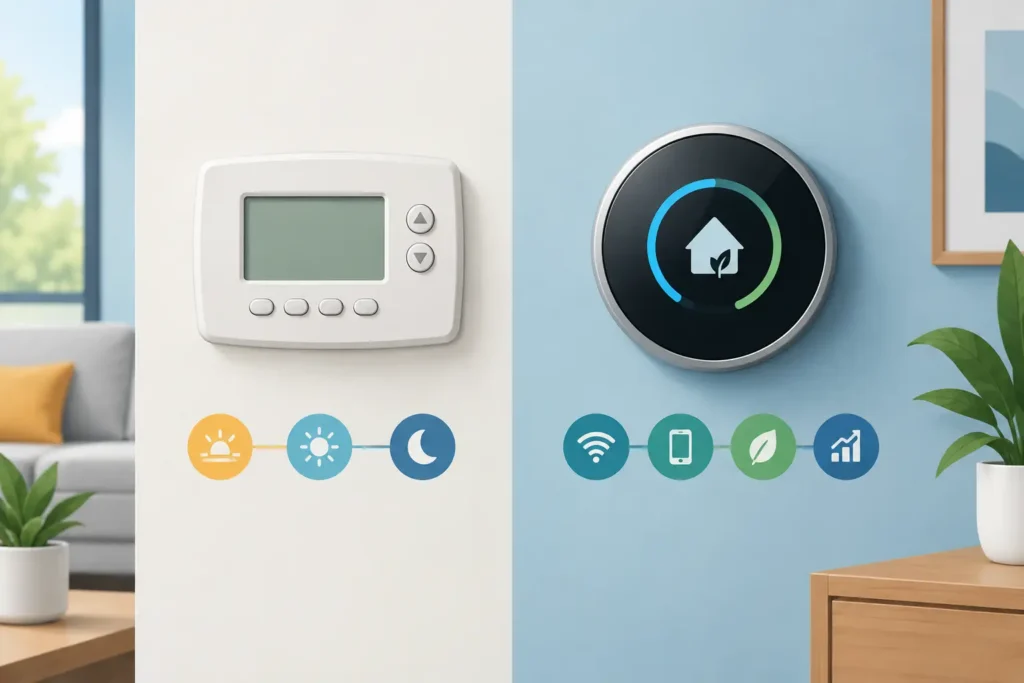
When a North Richland Hills summer pushes past 100 degrees, a thermostat is more than a wall control. It can affect how comfortable your family feels, how hard your AC runs, and what you pay each month. The programmable versus smart thermostat decision often comes down to one practical question: Do you want a set schedule, or do you want the thermostat to adjust around your life?
Both options can be a worthwhile upgrade from an old manual thermostat. The better choice depends on your daily routine, HVAC equipment, budget, and willingness to use an app. A smart thermostat is not automatically the right answer for every Fort Worth-area home, and a programmable model is not outdated when it is set up correctly.
Programmable Versus Smart Thermostat: The Real Difference
A programmable thermostat lets you set temperature changes for specific times and days. For example, you might set the air conditioning to cool your home before everyone wakes up, raise the temperature while the house is empty, and return to a comfortable setting before you get home. Most models offer different schedules for weekdays and weekends.
A smart thermostat can also follow schedules, but it connects to your Wi-Fi and gives you remote control through a phone app. Depending on the model, it may learn patterns, use occupancy sensors, respond to local weather conditions, send maintenance reminders, and work with certain home automation systems.
The key difference is control. A programmable thermostat follows the instructions you give it. A smart thermostat can provide more information and make adjustments based on settings, sensors, and your activity. That added convenience can be valuable, but it also means a higher purchase price and a little more setup.
When a Programmable Thermostat Makes Sense
A programmable thermostat is a solid, affordable choice for households with predictable routines. If your family leaves for work and school at the same time most weekdays, then returns at about the same time, a consistent schedule can reduce unnecessary heating and cooling without much effort.
It is also a practical option for homeowners who prefer simple controls. There is no app to download, no account to create, and no concern about Wi-Fi interruptions. You set the temperatures at the thermostat, review the schedule as seasons change, and let it do its job.
For rental homes, small offices, or properties where several people may need to operate the system, simple can be an advantage. A clear schedule is easier to understand than a connected device with multiple user permissions and automated features.
The trade-off is that programmable thermostats do not know when plans change. If you leave town for the weekend, get home early, or work from home unexpectedly, you need to change the setting yourself. Some homeowners also never program their thermostat after installation, which removes much of the energy-saving benefit.
What You Get With a Smart Thermostat
Smart thermostats work best for people whose schedules change often or who want to manage comfort from anywhere. If you are away from home and realize the AC has been running all afternoon, you can adjust it from your phone. If you are heading back from a trip, you can cool or heat the house before you arrive.
Many smart models offer alerts that can be useful in Texas weather. You may receive a notification if indoor temperatures rise unusually high, if the system seems to be running longer than expected, or if a filter reminder is due. These alerts do not replace professional maintenance or diagnostics, but they can help you spot an issue sooner.
Some models use geofencing, which uses your phone’s location to adjust temperatures when you leave or return. Others use room sensors to help address hot bedrooms, warm upstairs spaces, or rooms that stay cooler than the rest of the house. That can improve comfort, although a thermostat cannot fully correct problems caused by poor insulation, leaky ducts, an undersized system, or weak airflow.
Smart features also require realistic expectations. Learning schedules can take time, and automated adjustments may not match your comfort preferences right away. Wi-Fi-dependent features can be limited during an internet outage, though the thermostat should still operate the HVAC system from the wall controls. Homeowners who do not want notifications, apps, or regular software updates may find a programmable model less frustrating.
Energy Savings Depend on How You Use It
Neither thermostat type creates energy savings by itself. Savings come from avoiding unnecessary heating and cooling while maintaining reasonable comfort. In the Fort Worth area, that usually means allowing a slightly higher cooling setting when the home is empty during summer and avoiding dramatic temperature changes that make the system run hard to catch up.
A programmable thermostat can deliver that result when its schedule matches your routine. A smart thermostat can make it easier to maintain efficient settings when life is less predictable. For example, it may help a family that travels often, works varied shifts, or owns a second property.
Be careful about chasing the lowest possible temperature. Setting the AC extremely low will not cool the house faster. It only asks the system to run longer. A comfortable, consistent setting and a well-maintained HVAC system usually matter more than the logo on the thermostat.
Check Compatibility Before You Buy
Before installing either type, confirm that it works with your equipment. Most programmable thermostats are compatible with common central air conditioners, furnaces, and heat pumps. Smart thermostat compatibility can be more involved, especially with multistage equipment, heat pumps, whole-home humidifiers, zoning systems, or variable-speed systems.
Many smart thermostats need a common wire, often called a C-wire, to provide steady power. Some homes already have one behind the existing thermostat. Others may need a new wire, an adapter, or a different thermostat model. Improper wiring can damage a thermostat, cause short cycling, or leave heating and cooling equipment unresponsive.
Older homes around North Richland Hills, Hurst, Bedford, and Fort Worth may have existing wiring that needs a closer look. It is also worth checking whether the thermostat can properly control your system’s fan settings, auxiliary heat, and staging. A thermostat that is not configured for the equipment may reduce comfort instead of improving it.
How to Choose the Right Thermostat for Your Home
Start with your routine. Choose a programmable thermostat if your schedule is steady, you want simple operation, and keeping the upfront cost down is a priority. Choose a smart thermostat if remote access, changing schedules, energy tracking, and alerts would make your household easier to manage.
Then consider your HVAC system. A newer high-efficiency heat pump or multistage furnace may benefit from a thermostat designed to support its full capabilities. On the other hand, a basic single-stage AC system may not need an expensive model with features you will never use.
Finally, think about the comfort issue you are trying to solve. If your concern is a room that stays hot, a smart thermostat with room sensors may help identify a pattern. If your AC struggles to keep up everywhere in the house, the real problem may be refrigerant levels, airflow, insulation, ductwork, or aging equipment. A thermostat upgrade should support a healthy system, not mask a repair need.
Get the Setup Right From Day One
Correct installation and programming matter as much as the thermostat itself. A technician can verify wiring, confirm compatibility, set up heat pump or multistage controls, and make sure the schedule supports your comfort goals. Malcolm’s HVAC can help homeowners and property managers choose and install a thermostat that fits their equipment instead of pushing features they do not need.
A good thermostat should make comfort easier, not give you another device to manage. Choose the one that fits how your household actually lives, and let your HVAC system do the steady, dependable work it was built to do.