
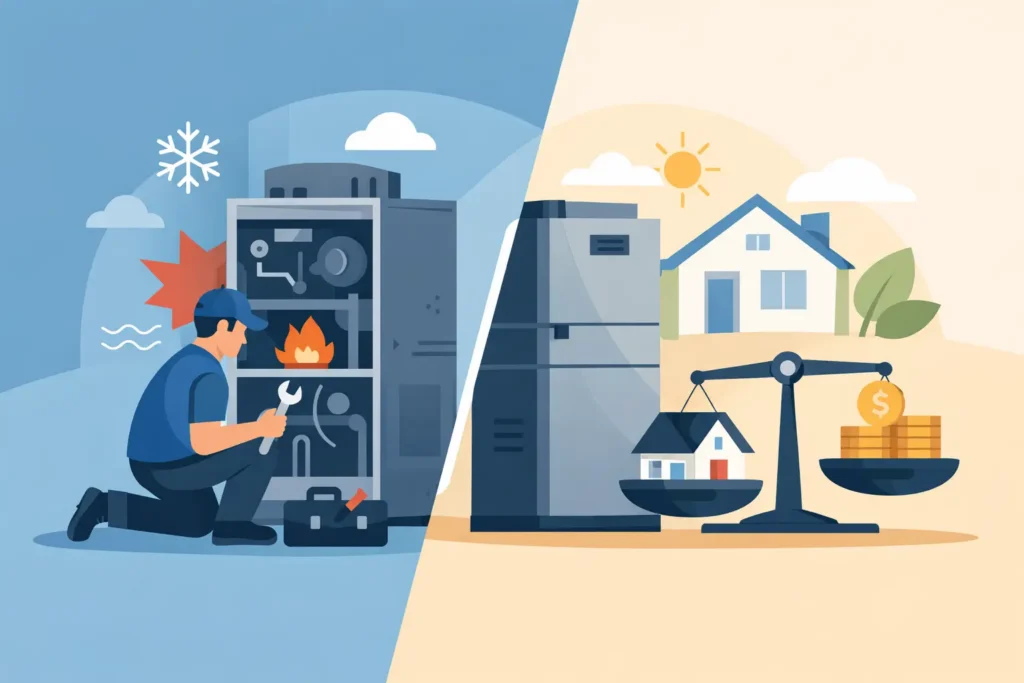
A furnace rarely quits at a convenient time. It starts making a strange noise on a cold night, runs longer than usual, or blows air that never seems warm enough. When that happens, the big question is usually furnace repair vs replacement – and the right answer depends on more than whether the system can be turned back on.
For homeowners and property managers in North Richland Hills, Fort Worth, and nearby areas, this decision often comes down to cost, reliability, and how much life is really left in the equipment. A repair may be the smart financial move. In other cases, putting more money into an aging furnace only delays a larger problem.
How to Think About Furnace Repair vs Replacement
The simplest way to look at it is this: repair makes sense when the issue is isolated and the furnace still has solid years ahead of it. Replacement makes sense when breakdowns are becoming frequent, operating costs are climbing, or safety and reliability are starting to become concerns.
That sounds straightforward, but real situations are rarely that clean. A furnace can still heat the house and still be a poor long-term investment. On the other hand, a furnace that suddenly stops working may only need a relatively small part and be worth fixing.
A good decision starts with four practical questions. How old is the furnace? What failed? How much will the repair cost? And how confident are you that another issue is not right around the corner?
When Furnace Repair Usually Makes Sense
Repair is often the better option when the furnace is under 10 to 12 years old and has been maintained reasonably well. Many common problems are repairable without turning the whole system into a money pit. Ignition issues, failed capacitors, blower motor problems, dirty flame sensors, thermostat malfunctions, and worn belts are all examples of repairs that may be worth making if the rest of the system is in good shape.
The same is true when the unit has a strong service history. If your furnace has been dependable for years and this is its first major issue, a repair can be the most cost-effective path. Paying for one targeted fix is very different from paying for repeated service calls every winter.
Efficiency matters here too. If your current furnace is still reasonably efficient and keeps the home comfortable without unusually high gas or electric bills, repairing it may preserve value. Not every older furnace needs to be replaced immediately. Some continue to perform well enough that a sensible repair is the financially responsible move.
For commercial property managers, the same logic applies. If the repair is predictable, downtime is manageable, and the furnace still supports reliable heating, replacement may be premature.
When Replacement Is the Better Long-Term Move
Age changes the conversation. Once a furnace is around 15 to 20 years old, replacement often deserves serious consideration even if the current problem seems repairable. Parts may become harder to find, efficiency falls behind modern standards, and one repair can quickly turn into two or three.
If your heating bills have been rising without a clear explanation, an older furnace may be losing performance. You are not just paying to fix it. You are paying month after month to operate equipment that may no longer be doing its job efficiently.
Frequent breakdowns are another major sign. A furnace that needs attention every season is not saving money anymore. It is creating uncertainty, especially during colder weather when you need dependable heat and fast service may be harder to schedule at peak demand times.
Replacement is also often the safer choice if there are concerns about a cracked heat exchanger, carbon monoxide risk, major corrosion, or substantial structural wear inside the cabinet. Safety issues change the math quickly. In those cases, the question is not just about repair cost. It is about protecting the people in the building.
The Cost Question Homeowners Always Ask
Most people want a clear rule, but there is no single number that decides furnace repair vs replacement in every case. Still, there are useful guidelines.
If a repair is relatively minor and the furnace is not near the end of its expected lifespan, repairing it usually makes sense. If the repair is expensive and the furnace is already old, replacement often provides better value. Some homeowners use a version of the old rule of multiplying the age of the furnace by the repair cost. If that number gets high, replacement starts to look more practical.
That rule can help, but it should not be the only factor. A 14-year-old furnace with one moderate repair need is different from a 14-year-old furnace that has had poor maintenance, inconsistent heating, and rising utility bills. Looking only at the invoice in front of you can hide the real cost of keeping worn equipment alive.
Upfront budget matters too. A repair is usually cheaper today. Replacement may save more over time but requires a larger immediate investment. That is why transparent pricing and financing options matter for many families and property owners. The right answer has to work not only mechanically, but financially.
Signs Your Furnace Is Telling You Something
Most furnaces give warnings before complete failure. If you notice uneven heating from room to room, more dust than usual, short cycling, unusual smells, rattling, banging, or squealing, those are all signs the system needs attention. Some of those issues point to a fixable repair. Others suggest broader wear.
Watch for comfort problems as much as mechanical ones. If the thermostat says one thing and the house feels another way, that gap matters. If your furnace runs constantly and still struggles to keep up, the system may be losing capacity.
An increase in repair frequency is often the clearest signal. One repair can be normal. A pattern of repairs usually means the furnace is entering a more expensive stage of its life.
Efficiency, Comfort, and the Bigger Picture
Replacement is not only about avoiding breakdowns. It can also improve comfort and lower operating costs. Newer furnace systems are generally more efficient than units installed 15 or 20 years ago, and that can show up in both monthly bills and day-to-day comfort.
A properly sized, professionally installed replacement can heat more evenly, cycle more effectively, and put less strain on the overall HVAC system. In some homes, replacing an outdated furnace also helps with airflow problems that homeowners had started treating as normal.
That said, efficiency alone does not always justify replacement. If your furnace is still operating reliably and the repair is reasonable, replacing it strictly for efficiency may not provide the fastest payoff. This is one of those areas where it depends on your current system, usage habits, and how long you plan to stay in the property.
Why a Professional Inspection Matters
The smartest decision usually comes after a full inspection, not a guess based on age alone. A technician can evaluate the condition of major components, measure performance, identify safety issues, and explain whether the current problem is isolated or part of a larger pattern.
That matters because two furnaces of the same age can be in very different condition. One may have years left. The other may be hanging on with multiple worn components. Honest guidance should include both options when both options are reasonable.
That straightforward approach is what many local customers want most. They do not need pressure. They need clear information, realistic pricing, and a recommendation that fits the home, the building, and the budget. That is the kind of service Malcolm’s HVAC aims to provide across North Richland Hills and the greater Fort Worth area.
Making the Right Call for Your Home or Property
If your furnace is newer, the repair is manageable, and the system has been dependable, repair is often the right move. If your furnace is older, less efficient, and starting to fail in more than one way, replacement usually offers better long-term value.
The key is not choosing the cheaper option in the moment. It is choosing the option that gives you safe, reliable heat without putting you back in the same situation a few months from now.
If you are weighing furnace repair vs replacement, do not wait until a small warning sign turns into a no-heat emergency. A clear diagnosis today can save money, stress, and a cold house later.